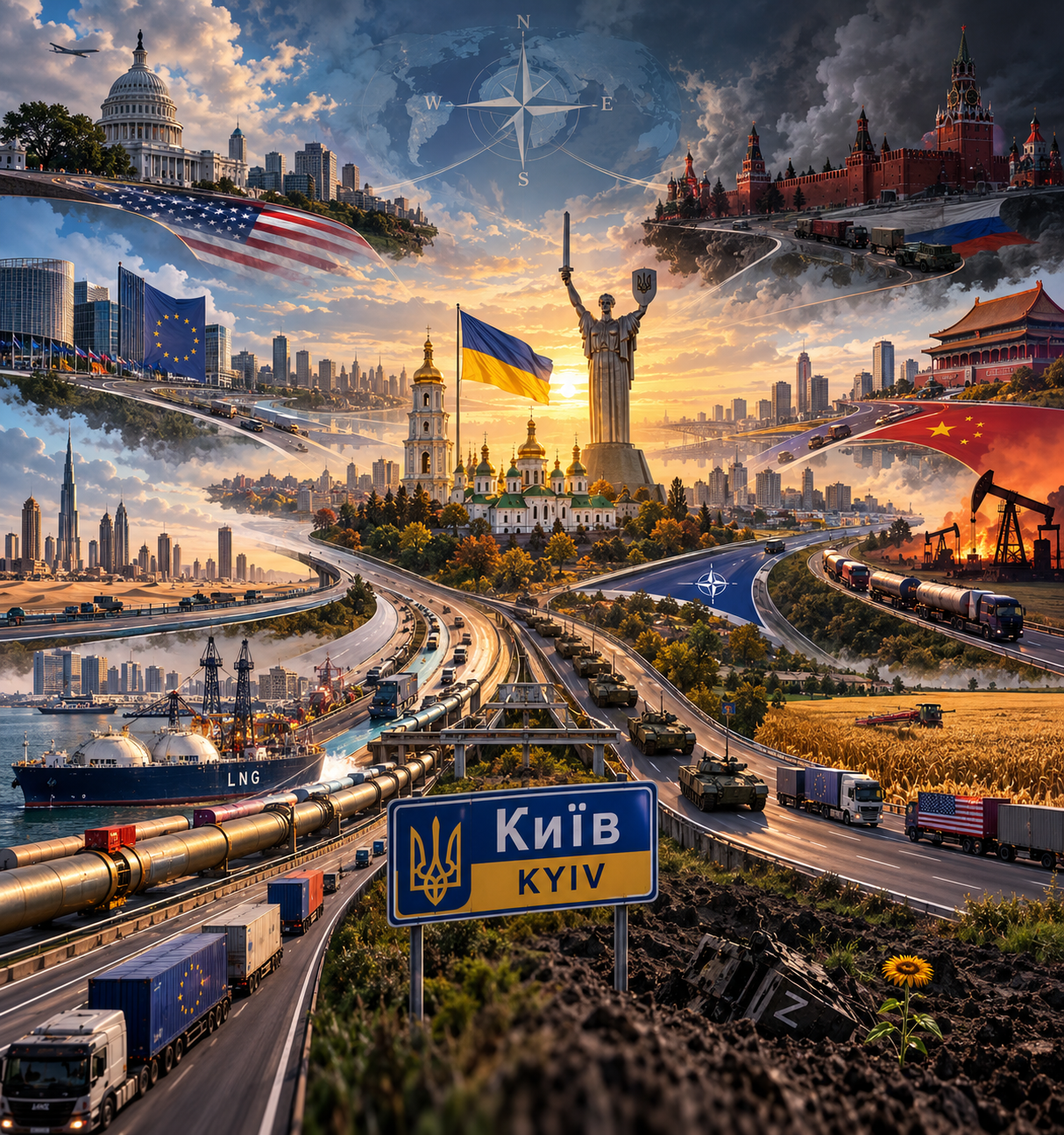
There is an old saying: all roads lead to Rome. It once reflected the idea that Rome was the centre of the world—a place where trade routes, political interests and the fate of entire peoples converged.
Today, that saying has acquired an unexpected sequel.
All roads lead to Kyiv.
Not because Ukraine rules the world. Not because the price of every barrel of oil, the composition of European governments or the outcome of American elections is decided in Kyiv. And certainly not because Ukrainians have somehow learned to control international institutions that are failing to meet their responsibilities.
The point is something else.
Russia’s war against Ukraine has become one of the most important stress tests of the international order. It exposes contradictions: between international law and the mechanisms that actually enforce it; between economic interdependence and geopolitical confrontation; and between the commitments made by Western democracies and their willingness to bear the costs of defending their own principles.
The question of Ukraine touches European defence, energy markets, food security, sanctions policy, the resilience of democratic institutions and the future of transatlantic relations.
That does not mean that every global problem was caused by the war in Ukraine. On the contrary, many of them existed long before February 2022.
But they have become much harder to ignore.
Here lies the central paradox: Ukraine is not the centre of the universe. Yet what happens there is forcing numerous states to rethink their view of the world.
The world has entered an era of competition—and this is no longer just a Ukrainian assessment
To understand how closely the war in Ukraine is connected to the wider crisis in international relations, it is worth looking at a report that can hardly be accused of being written solely from a Ukrainian perspective.
In January 2026, the World Economic Forum published its Global Risks Report 2026. More than 1,300 experts from around the world took part in the underlying survey. Geoeconomic confrontation ranked first, with 18 per cent of responses, among the risks that could trigger a major global crisis in 2026. Interstate armed conflict came second, at 14 per cent.
These figures need to be interpreted correctly. They reflect experts’ assessment of risks, not a statistically calculated probability of a global catastrophe. Even so, the result is revealing: economic competition, armed conflict and the weakening of international cooperation are not viewed as separate phenomena, but as interconnected dangers.
The report describes a broader shift: international relations are increasingly shaped by rivalry, the use of trade and finance as instruments of pressure, and declining trust between states.
This is precisely where Ukraine’s story takes on global significance.
Russia is using military force to pursue political aims. Other states are responding with sanctions, military support for Ukraine, export restrictions and changes to their defence strategies. Economic ties that might otherwise create a shared interest in stability are themselves becoming tools of geopolitical confrontation.
The war therefore affects not only front lines, but also trade routes, investment decisions, public budgets and relations between allies.
The world is not necessarily less interconnected. It is interconnected in a different way: through competition, dependence on critical resources and the need to account for the consequences of decisions made elsewhere.
Ukraine is one of the key places where this new reality is especially visible.
International law: the rules exist. What happens when they are violated?
One of the most uncomfortable questions raised by the war against Ukraine is this: what does international law mean when a state that violates its basic principles can continue a war for years?
The Charter of the United Nations enshrines the principle of the sovereign equality of states and prohibits the use of force against another state’s territorial integrity or political independence, subject to the exceptions provided for under international law.
The international system, however, has no universal mechanism that automatically stops an act of aggression once it begins.
The UN Security Council has primary responsibility for maintaining international peace and security. But the veto power held by its permanent members limits the Council’s ability to act against one of those members. The International Court of Justice and the International Criminal Court have different functions; they are not universal enforcement bodies capable of ending hostilities on their own.
That does not make international law a fiction. It establishes binding rules, provides a basis for accountability, enables the documentation of violations and makes legal action possible. But there is a fundamental difference between a rule existing and that rule being enforced.
The war against Ukraine has made this gap particularly visible.
In its conclusions of 18 June 2026, the European Council reaffirmed support for Ukraine’s territorial integrity, stated that borders must not be changed by force and stressed that the path to peace cannot be determined without Ukraine itself. European leaders also linked Russia’s continuing aggression to the need to strengthen Europe’s defence, support Ukraine and reduce Russia’s revenue from energy exports.
This reveals a fundamental contradiction in international politics.
On the one hand, European states reaffirm the universal principles of sovereignty and territorial integrity. On the other, they acknowledge that protecting those principles requires military capabilities, financial resources, sanctions and sustained political will.
In other words, legal norms do not eliminate the need for power capable of deterring their violation.
The question is not whether we need international law, but how it can be made effective in a world where some states are willing to pay a high price to disregard it.
Ukraine did not create this problem. It has become the state whose experience makes its consequences impossible to ignore.
Europe realises that it cannot delegate its security indefinitely
For a long time, European security rested on a combination of national defence capabilities, American guarantees, NATO and the assumption that a major war between states on the continent was unlikely.
Russia’s invasion of Ukraine changed that calculation.
The study Defending Europe, Deterring Russia, published in June 2026 by the EU Institute for Security Studies, examines the need to strengthen Europe’s defence capabilities in light of the continuing Russian threat and uncertainty about the scale and durability of American support. It also analyses hybrid operations, sabotage, cyberattacks and Russia’s ability to rebuild its military potential.
Estimates of the timeframes in which Russia could become a heightened military threat to NATO states remain risk assessments; they are not fixed dates for a future attack.
The assessment of Estonia’s Foreign Intelligence Service is also instructive.
In its report International Security and Estonia 2026, published on 10 February 2026, the service said it did not believe Russia intended to attack Estonia or another NATO member within the next year. At the same time, it warned that Russian military reform would increase the capabilities of Russia’s armed forces in the coming years and emphasised the need to continue strengthening defence.
That distinction matters: the absence of an apparent intention to attack NATO immediately does not mean that no long-term threat exists.
It does not follow that the war against Ukraine will inevitably escalate into a war with NATO. That would be an overstatement. It does follow that European states must plan their defence with potential further growth in Russian military capabilities and unstable foreign-policy conditions in mind.
Once again, Kyiv is at the crossroads of European interests.
Support for Ukraine can constrain Russia’s ability to wage war and give European states time to strengthen their own armed forces. That does not mean, however, that the Ukrainian army can replace European defence or that the continent’s entire security depends solely on the outcome of fighting on Ukrainian territory.
Europe must defend itself while helping Ukraine defend itself against aggression.
That is why the question of continuing military support for Kyiv is not merely a question of solidarity. It also concerns strategic calculations, defence spending and the level of risk European states are prepared to accept in the future.
Ukraine does not need to tell Europe how much to spend on its own security. But Russia’s war has made postponing that decision considerably riskier.
Oil, diesel and the cost of decisions made elsewhere
The energy economy shows particularly clearly how difficult it is to separate the war in Ukraine from the global economy.
Two connected but distinct processes need to be distinguished.
The first concerns Russia’s revenue from oil and gas exports, which matters for the state budget and for financing the war.
The second concerns global energy prices. These depend on worldwide supply and demand, production capacity, transport routes, sanctions and conflicts in different regions.
The Kyiv School of Economics Institute systematically tracks Russia’s energy revenue, oil exports, the activities of the so-called shadow fleet and the effectiveness of sanctions. Its monthly analyses, Russia Chartbook and Russian Oil Tracker, examine how changes in energy markets affect the Russian economy and the financing of the war.
In March 2026, the KSE Institute separately warned that an escalation of the conflict in the Middle East, damage to energy infrastructure in the region and restrictions on shipping through the Strait of Hormuz were creating conditions for higher global prices. Sustained high prices could increase Russia’s export revenue and ease pressure on its state budget.
This is an example of how two conflicts in different regions can affect one another through the global energy market.
A war in the Middle East can increase Russia’s income from energy exports. That income can in turn expand the financial resources available to continue the war against Ukraine. At the same time, sanctions, Ukrainian strikes on Russian refineries and export restrictions affect parts of Russia’s energy system.
None of these factors alone determines global prices.
That is precisely why claims that Ukraine independently controls global fuel prices are an obvious exaggeration. They are, however, based on a real phenomenon: events in Ukraine can influence the decisions of market participants and political debates far beyond its borders.
The same is true of food.
In August 2026, Reuters reported major problems with Ukrainian grain exports amid Russian attacks on port infrastructure and civilian vessels in the Black Sea. According to figures attributed in the report to Ukraine’s agriculture minister, alternative routes could handle only about half of the volume previously transported through Black Sea ports. In recent seasons, Ukraine accounted for around six per cent of global wheat exports and 11 per cent of global maize exports.
That does not mean that every increase in global food prices is caused by Russian aggression. Crop yields, weather, fertiliser costs, logistics, demand and trade policy also affect food markets.
But when the supply of a significant exporting country is disrupted, the consequences can reach far beyond the war zone.
Energy and food therefore show the same pattern: the war affects not only the territory where the fighting takes place, but also international supply chains, prices and political decisions.
Not every road leads to Kyiv. But some of the routes used to transport oil, grain and money do pass through the consequences of the war against Ukraine.
Democracies must defend themselves without ceasing to be democracies
Russia’s aggression has posed another difficult challenge to Western democracies: how can they protect themselves from external pressure without abandoning their own political principles?
Influence over public opinion, information operations, cyberattacks, election interference and the exploitation of internal divisions can create threats without an army crossing a border.
Precision is essential here.
Not every political disagreement in a Western society is organised by Moscow. Not every scandal, protest or dispute between allies proves that Russia is conducting an operation. In its 2026 report, Estonia’s Foreign Intelligence Service explicitly warned against seeing an elaborate Kremlin plan behind every event: Russian influence operations and sabotage exist, but not every apparent alignment is part of a single plan.
That qualification is especially important if we want to understand threats rather than create a myth of an all-powerful adversary.
At the same time, the European Council’s conclusions of June 2026 explicitly refer to Russian information manipulation and interference, as well as threats to European security linked to the continuing war.
Western states face a difficult task: detecting and countering hostile operations while preserving freedom of expression, political competition and independent institutions.
Excessive suspicion can destroy trust just as disinformation can. An inadequate response, in turn, can allow external actors to exploit the openness of democratic societies.
Ukraine is at the centre of this debate for objective reasons. It is at war with a state waging a full-scale war of aggression against it, while also depending on the political will of its democratic allies.
But Ukraine does not relieve American and European politicians of responsibility for their own decisions. Domestic polarisation, economic difficulties and distrust of public institutions have many causes that cannot be reduced to foreign interference.
When Ukraine becomes a subject of domestic political disputes in the United States or Europe, it shows how important foreign policy has become to the internal life of those states. It does not make Kyiv the director of other countries’ election campaigns.
This brings us closer to the central satirical image of this essay.
A country that can do everything. At least in other people’s accounts
Imagine a country whose territory contains a peninsula washed by the waters of four oceans.
A country with roads so majestic that a thousand tanks can move along them at once in a battle formation, while the black soil on either side is so fertile that it could swallow all thousand of them at once.
A country that controls global fuel prices, determines the future of European security, calls the effectiveness of international institutions into question and—according to some accounts—almost single-handedly decides the fate of American elections.
A country that somehow manages to threaten some heads of state, spoil lucrative deals for others and become the convenient explanation for practically every political or economic failure.
Where else could one find such a magnificent state?
Of course, geography gets in the way a little. Ukraine does not have a peninsula washed by four oceans. Its roads were not designed for endless tank columns, and even its exceptionally fertile black soil cannot swallow armoured vehicles on government order.
But in the political imagination, anything is possible.
Especially when Ukraine is concerned.
In one political narrative, Ukraine is a weak state that cannot exist without foreign aid. In another, it is a power that can collapse energy markets, wreck diplomatic plans, draw great powers into a conflict and influence elections on the other side of the world.
Both images can serve those who promote them. The first allows Ukraine’s agency to be underestimated. The second helps explain one’s own difficulties through the actions of an outside actor.
As so often, reality is more complicated.
Ukraine has its own interests, an army, political institutions, economic resources and clear limits to its power. Its decisions have consequences, but they do not erase the independence of other states. Its resilience matters to Europe, but it does not make Kyiv responsible for every problem in European politics.
Ukraine can influence events without controlling them completely.
Perhaps this is especially difficult to accept for those accustomed to thinking in terms of absolute power or absolute dependence.
Kyiv as a mirror of the world
There is another reason why the question of Ukraine keeps returning to the international agenda.
It forces states to take a position not only on a particular war, but also on the principles that guide them.
Which matters more: territorial integrity or short-term economic advantage? How can the desire for peace be reconciled with the need not to reward aggression? Can a lasting agreement succeed if one side treats military force as a means of changing borders? Should allies help an attacked state even when that assistance carries political and economic costs for them?
There are no simple answers to these questions. But avoiding them is becoming increasingly difficult.
For European states, the war means rethinking defence and strategic autonomy. For the United States, it means balancing global commitments, relations with allies and competing domestic priorities. For international organisations, it means finding ways to act when political divisions limit the use of existing mechanisms. States outside Europe must consider the consequences of the war for trade, energy, food and international norms.
Ukraine is not the only place where these contradictions meet. Other regions have their own conflicts, threats and centres of power. It would be a mistake to reduce everything happening in the world to one country.
But the war in Ukraine has become one of the central junctions where several global problems converge.
That is why this is not only about Ukraine’s future. It is also about the rules that will govern international relations after the war, the lessons potential aggressors will draw and the credibility of security guarantees for states that do not want to be next.
In this sense, Kyiv really does lie at the crossroads of many roads.
Not because the whole world must look to Ukraine, but because the consequences of the war will not let the world look away forever.
All roads lead to Kyiv. But where does the road from Kyiv lead?
The old saying about Rome assumed a centre toward which the roads converged. Modern geopolitics is more complicated: it has no single centre, and events in different regions can change the direction of the entire system.
Ukraine does not rule this world. It does not set global market prices on its own, decide the outcome of American elections or force international organisations to function as their founders intended.
Yet Ukraine is in a position where its struggle for survival raises questions on which other states also depend.
This is not Ukrainian omnipotence, but a responsibility—above all to its own citizens, who bear the direct cost of the war, and to the future of their country.
The rest of the world must draw its own conclusions too.
One can regard Ukraine as an inconvenient obstacle, a risk factor, a subject for diplomatic bargaining or an awkward issue in domestic politics. One can try to separate its fate from one’s own interests. One can blame Ukraine for rising prices, failed negotiations and contradictions in the international order.
But geography, economics and security do not disappear just because they are uncomfortable to discuss.
Russia’s war against Ukraine has already become part of twenty-first-century history. How it ends, what security guarantees are created and what lessons states draw from it will shape international relations far beyond Europe.
That is why all roads lead to Kyiv—not to a capital that gives orders to the world, but to a place where the world must put its own promises to the test.
And then make decisions.
When diplomatic language, market calculations, campaign statements and debates about the world order fall silent, what remains is not an abstract geopolitical construct.
A country remains.
Its cities and villages. Its people. Its land. Its language. Its right to determine its own future.
A country that does not have to rule the entire world to earn its place in it.
Holy Ukraine, my own—eternal and unconquerable.
Sources and editorial notes
The following sources underpin the analyses cited in the article. Before publication, the currency, exact figures and original wording of all time-sensitive claims should be checked again.
World Economic Forum – Global Risks Report 2026 — https://www.weforum.org/publications/global-risks-report-2026/
European Council – Conclusions of 18 June 2026 on Ukraine and European defence — https://www.consilium.europa.eu/en/press/press-releases/2026/06/18/european-council-conclusions-on-ukraine-and-on-european-defence-and-security/
EU Institute for Security Studies – Defending Europe, Deterring Russia — https://www.jstor.org/stable/resrep79811
Estonian Foreign Intelligence Service – International Security and Estonia 2026 — https://valisluureamet.ee/doc/raport/2026-en.pdf
Kyiv School of Economics Institute – Sanctions analysis — https://sanctions.kse.ua/en/sanctions-analytics/
Reuters – Ukrainian grain exports and attacks on port infrastructure (August 2026) — https://www.reuters.com/world/ukraine-turns-alternative-grain-export-routes-counts-losses-russia-blocks-ports-2026-08-04/
Spelling note: The Ukrainian capital is written throughout as “Kyiv”, in line with the Ukrainian Київ rather than the Russian form Киев. The title therefore reads “Do all roads lead to Kyiv?”
Editorial note: The illustration is a bespoke symbolic depiction, not a documentary photograph. Before publication, time-sensitive statements and figures should be checked against the original sources.