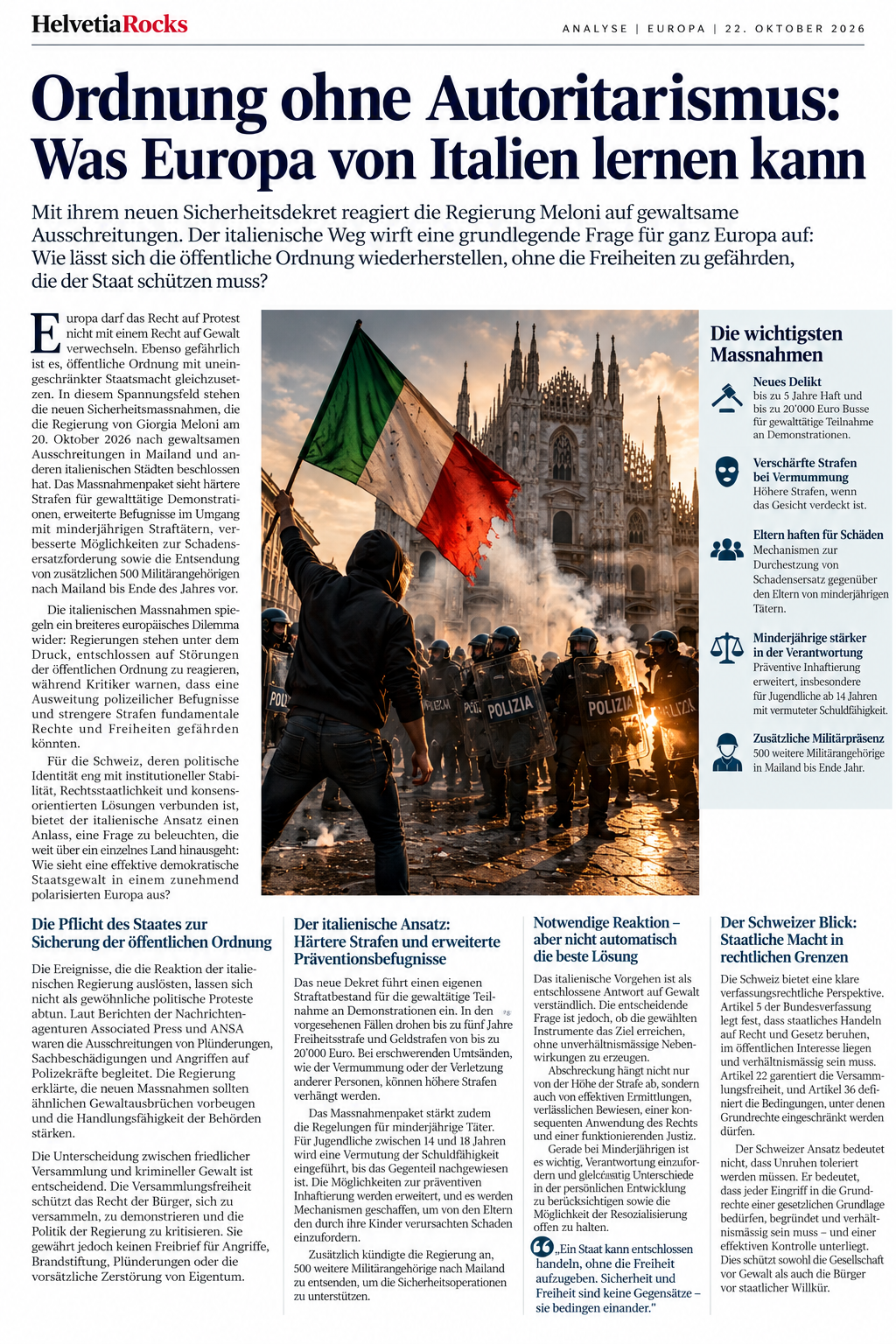
The state has a duty to protect public order
The events that prompted the Italian government to respond cannot simply be dismissed as ordinary political protests.
According to reports by the Associated Press and the Italian news agency ANSA, the unrest involved looting, property damage and attacks on police. The government said the new measures were intended to prevent similar incidents and strengthen the authorities’ ability to act.
The distinction between a peaceful assembly and criminal violence is essential. Freedom of assembly protects people’s right to gather, demonstrate and criticise government policy. It does not grant impunity for assault, arson, looting or deliberate property damage.
When shops are looted or people are threatened, they are entitled to expect effective protection from the state. Repeated failures to enforce the law can undermine trust in democratic institutions.
The answer cannot be to tolerate violence in the name of freedom. Democratic freedom depends on a functioning legal order that protects everyone’s rights, including those of people who do not take part in demonstrations. Conversely, the occurrence of violence does not automatically justify every state countermeasure.
Italy’s new approach: tougher penalties and wider preventive powers
The Italian decree creates a new offence relating to violent participation in demonstrations. In the cases covered, it provides for prison sentences of up to five years and fines of up to 20,000 euros. Stricter sanctions may apply in certain aggravating circumstances, such as wearing a face covering or injuring another person.
The package also tightens rules for young offenders. For adolescents aged 14 to 18, a presumption of criminal responsibility is to apply unless the contrary is established. The scope for preventive detention is being expanded; mechanisms are also planned to recover from parents the cost of damage caused by their children.
The government also announced that it would send 500 additional members of the armed forces to Milan to support security operations.
These measures should not be treated as a single instrument. Penalties, parental liability for damage, preventive detention and the deployment of the military each raise distinct legal and practical questions. Each measure requires its own justification.
Financial liability for parents can, for example, help compensate victims. It must not be equated with automatic criminal guilt on the part of parents for every act committed by their children. Preventive detention likewise requires clear legal conditions, safeguards against arbitrary use and effective judicial oversight.
The legislative process also matters: Parliament must convert the decree into law within the prescribed 60-day period. The final wording and its practical application are therefore as important as the initial announcement.
A necessary response is not automatically a sufficient one
The Italian government presents the measures as a resolute response to violence. The aim is understandable. The harder question is whether the chosen tools will be effective without causing disproportionate consequences.
Deterrence does not depend solely on the severity of a sentence. It also depends on whether offences are investigated effectively, evidence is gathered reliably, laws are applied consistently and proceedings are concluded within a reasonable time.
Higher penalties can be justified in some circumstances, but on their own they do not guarantee a fall in crime. Credible security policy requires professional policing, effective prosecution, proportionate sanctions and action on the conditions in which violence repeatedly arises.
This is especially important when minors are involved. Young offenders must be held accountable, and victims must not be left without protection. At the same time, the justice system must take age, individual responsibility and the possibility of rehabilitation into account.
A policy that responds only after violence breaks out remains incomplete. Schools, families, local authorities, social services and the police share responsibility for protecting young people from destructive groups and ensuring that serious offences have consequences.
The danger of turning protest into an enemy of the state
Another risk is to attribute the conduct of a few individuals to an entire political movement or to all demonstrators.
Political violence can emerge in different ideological settings. The fact that some participants commit offences proves neither that all demonstrators share the same aims or methods nor that an entire demonstration was organised by a particular political group.
Claims about the involvement of extremist organisations must be supported by evidence concerning the specific people, their actions and proven organisational links. This is not a concession to extremism; it is a condition for factual analysis and policing governed by the rule of law.
When governments portray broad groups of political opposition as a threat to public order, they risk alienating peaceful citizens and weakening the legitimacy of their own actions. Commentators make the same fundamental mistake when they play down violence simply because they share the protesters’ stated aims.
A democratic state must reject both forms of selective judgment. The law should be guided by proven conduct, not solely by a person’s political identity.
The Swiss perspective: state power within legal limits
Switzerland offers a useful constitutional perspective on this debate, even though its political system and security structures differ from Italy’s.
Article 5 of the Swiss Federal Constitution requires state action to be based on law, limited by law, in the public interest and proportionate. Article 22 guarantees freedom of assembly; Article 36 sets out the conditions under which fundamental rights may be restricted, including a legal basis, a public interest and proportionality.
These principles are not abstract formulas. They provide a standard for assessing the legitimacy of security measures.
The Swiss approach does not mean tolerating disorder or accepting ineffective law enforcement. It means that state power must have a legal basis and be exercised as necessary and proportionately.
Authorities should be able to explain why a restriction is necessary, why less intrusive alternatives may not be sufficient and what safeguards prevent abuse. This standard protects both sides of the relationship between citizens and the state: society from violence and citizens from arbitrariness.
Switzerland should not assume that its institutions automatically provide an answer to every security question. Nor should it declare another country’s policy illegitimate simply because it is more restrictive. The key questions are whether a measure is necessary, effective, proportionate and subject to effective oversight.
Europe needs confidence in the rule of law, not a permanent state of emergency
The Italian debate points to a broader challenge for European democracies. Governments are expected to provide security, citizens demand accountability, and political polarisation makes almost every security measure appear to be a victory for one ideological camp over another.
In these circumstances, restraint is sometimes mistaken for weakness, while toughness is treated as proof of political competence. Neither assumption is reliable.
A state can act decisively without becoming arbitrary. It can protect demonstrations while prosecuting violence. It can hold offenders accountable while ensuring fair, lawful proceedings. It can strengthen its operational capacity without losing sight of the different roles of the police and the armed forces.
The goal must be a state strong enough to enforce the law and sufficiently constrained to prevent abuses of power.
That requires clear laws, professional police forces, independent courts, reliable evidence, transparent communication and critical scrutiny of results. Political leaders should also resist the temptation to use every episode of unrest as an argument for unlimited extensions of their powers.
A security policy should not be judged by the harshness of its rhetoric or the number of forces deployed. The decisive question is whether it makes people safer while preserving democracy’s legal and institutional foundations.
A Swiss lesson for Europe
Switzerland’s possible contribution to the European debate is not to lecture other states or claim moral superiority. It is to apply consistent standards against which every government can be assessed.
Public order matters. Victims are entitled to justice. People who commit violence must face consequences. Peaceful assemblies must remain protected. State power must be exercised within the law. These principles do not conflict; they reinforce one another.
Italy’s new decree may give authorities additional tools to address serious disturbances of public order. Whether those tools are effective and proportionate will depend on the final wording, how it is applied and what safeguards accompany it.
Europe should assess the actual results instead of prematurely celebrating repressive policy as a success or rejecting every stricter measure in principle.
Democratic authority is most convincing when it can protect citizens without becoming a threat to their rights. The rule of law is not an obstacle to effective government. It distinguishes a capable democratic state from power exercised without adequate limits.
For a continent facing political polarisation, violent unrest and declining trust in institutions, that distinction is fundamental.
The choice is not between order and freedom. It is between a state that can protect both and one that sacrifices one in the name of the other.