ANALYSIS | HYBRID WARFARE | 20 October 2026
A war that does not begin with tanks
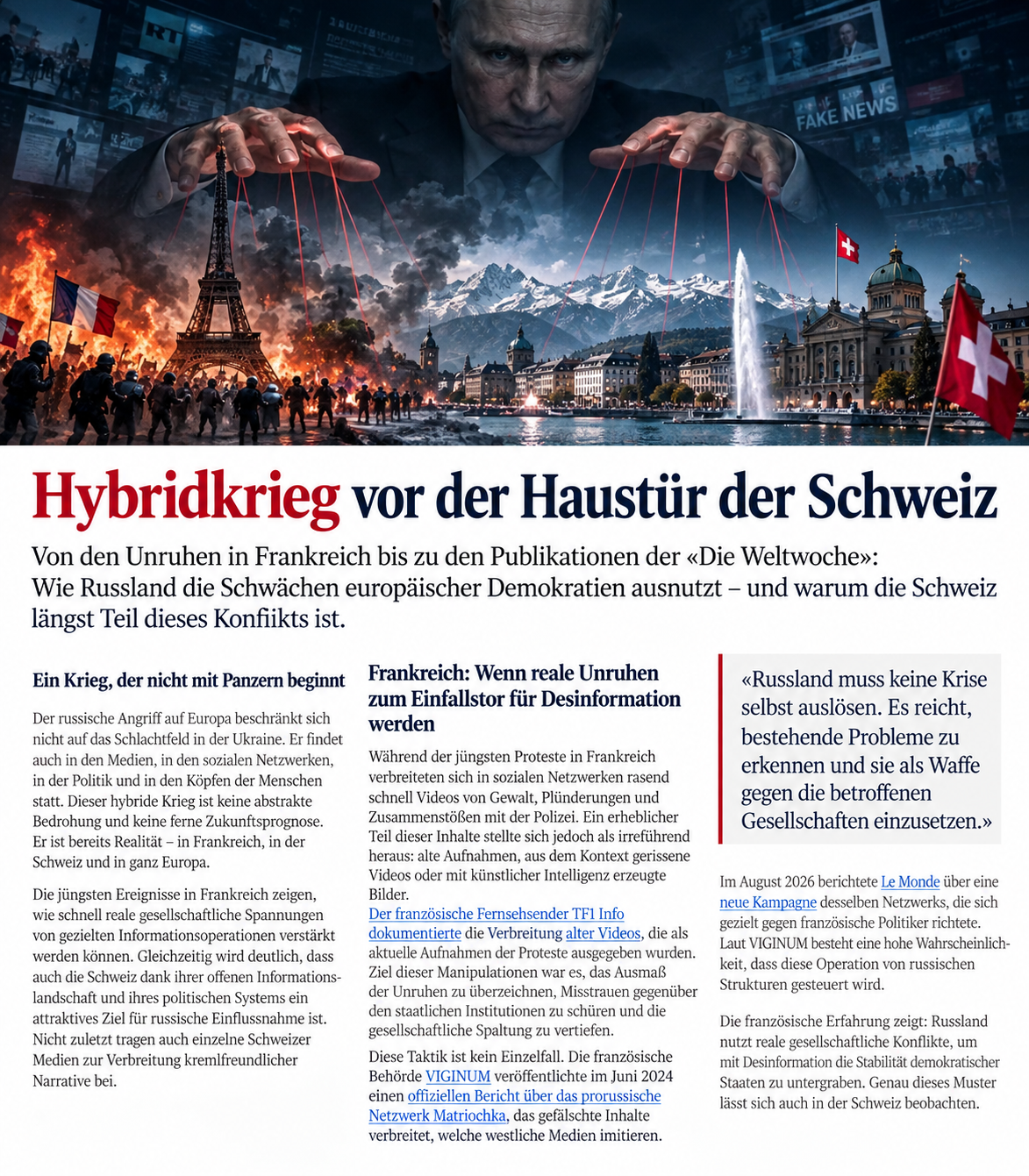
Russia’s attack on Europe is not confined to the battlefield in Ukraine. It also takes place in the media, on social networks, in politics and in people’s minds. This hybrid war is neither an abstract threat nor a distant forecast. It is already a reality—in France, in Switzerland and across Europe.
Recent events in France show how quickly real social tensions can be amplified by targeted information operations. They also make clear that Switzerland, with its open information environment and political system, is an attractive target for Russian influence. Some Swiss media can also contribute to the spread of Kremlin-friendly narratives.
France: when real unrest becomes an entry point for disinformation
During recent protests in France, videos of violence, looting and clashes with police spread rapidly on social networks. Some of this material proved misleading: it consisted of old footage or videos taken out of context.
French broadcaster TF1 Info documented old videos being presented as current footage of the protests. Such misrepresentations can exaggerate the scale of unrest, fuel distrust in public institutions and deepen social tensions. [1]
This tactic is not an isolated case. In June 2024, the French agency VIGINUM published an official report on the pro-Russian Matriochka network. It described a coordinated campaign that spread fabricated content mimicking publications by Western media. [2]
In August 2026, Le Monde reported on a new campaign by the same network targeting French politicians. According to the report, VIGINUM attributed the operation to pro-Russian actors with a high degree of confidence. [3]
Switzerland: neutrality is no shield
This development is directly relevant to Switzerland. Neutrality defines a state’s foreign-policy status, but it does not automatically protect it from espionage, cyberattacks, disinformation or other forms of hybrid influence.
SWI swissinfo.ch reported on Russian disinformation in Switzerland. According to Federal Councillor Martin Pfister, quoted in the report, pro-Russian actors coordinated the spread in May 2025 of a video from Geneva taken out of context. The posts were intended to create the impression that Switzerland was descending into chaos and was no longer neutral. [4]
The Swiss Federal Council also treats disinformation and foreign influence as security challenges. Switzerland’s 2026 Security Policy Strategy says hybrid conflict—from disinformation and cyberattacks to espionage and sabotage—has increased in Europe and can also affect Switzerland. [5]
When domestic media amplify foreign narratives
Another question concerns the role of the media at home. In Switzerland, Die Weltwoche has also come under criticism. The organisation Fairmedia examined the Swiss magazine’s use of content from the Russian state media outlet RT. Among other things, it criticised an article that portrayed the Bucha massacre as staged. [6]
This is more than a matter of differing political opinions. When a Swiss media outlet adopts claims from Russian state media that discredit documented crimes by the Russian army, it objectively contributes to the spread of a narrative useful to the Kremlin.
The use of RT material alone does not prove coordination with Russian intelligence services. The effects also matter: which claims are spread, which facts are distorted, and how does this influence perceptions of Russian aggression? Press freedom does not release editorial teams from the duty to scrutinise their sources.
Russia does not have to cause every crisis itself. It is enough to identify existing problems and use them as weapons against the societies affected.
Every weakness becomes an opportunity for the adversary
France and Switzerland show different sides of the same problem. In France, street unrest and public anger can provide material for information operations. In Switzerland, political differences, debates about neutrality and doubts about public institutions can be exploited. The basic principle remains the same: Russia turns democratic states’ weaknesses against them.
Bureaucratic delays, hesitant decisions, security-agency mistakes, a lack of transparency and declining trust create openings for influence. A state that reacts too late, fails to explain its decisions clearly or does not correct its own mistakes makes it easier for an adversary to intensify existing conflicts.
The answer cannot be to label every domestic political dispute Russian interference. It must be to make state institutions more resilient, provide information promptly and clearly, and consistently expose disinformation. A democracy protects itself not by hiding its problems, but by being able to resolve them effectively under the rule of law.
Europe should learn from Ukraine’s experience
Ukraine has particular practical experience in this respect. It has resisted Russian aggression for years and shows how closely military security, social cohesion and the protection of the information space are connected.
Switzerland does not need to go through the same experiences before drawing conclusions. It must recognise its own vulnerabilities and prevent an external adversary from turning internal problems into weapons against the state and society.