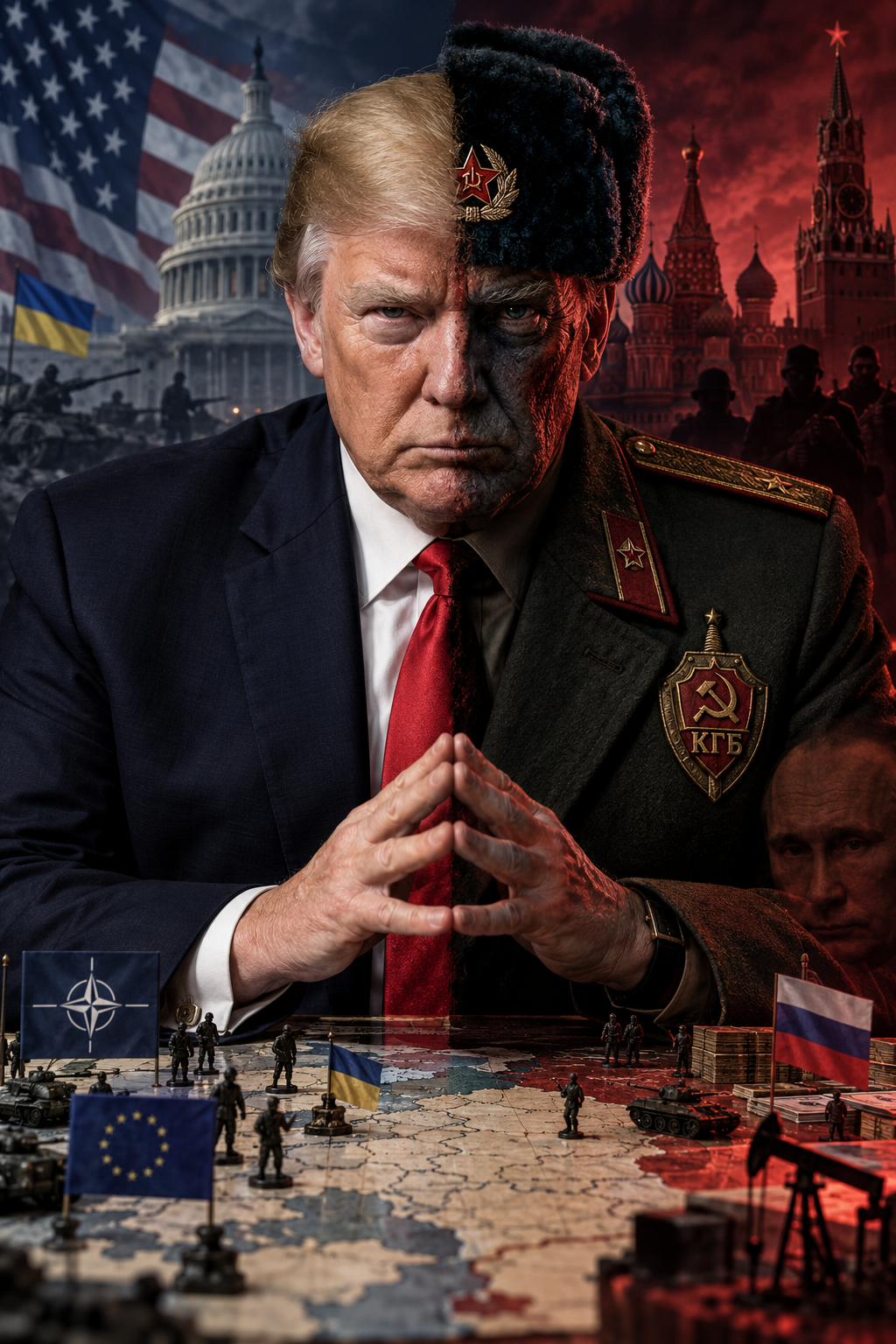
Editorial note: This is an analytical commentary. The hypothesis that Trump was recruited by the KGB or is being directed by Russian services has not been publicly substantiated. The text distinguishes between facts, political assessments and hypothetical considerations.
Dear readers,
For a long time, our editorial team discussed whether we should write this article at all. Once the first draft was ready, another question arose: should we publish a text on such a sensitive subject, raising a question that until recently might have seemed like a conspiracy theory?
We are aware of the gravity of the subject. The allegation that the President of the United States has links to a foreign intelligence service is not an excuse for a sensational headline. It requires solid evidence. We will not present as established fact what has not been proven.
There is, however, another side to the question. We live in a time when international events unfold like a cascade: one crisis follows another. Decisions and statements from Washington can change Ukraine’s situation within days, affect Europe’s security, call the reliability of transatlantic alliances into question and shift the Kremlin’s strategic calculations.
Donald Trump is at the centre of many of these developments. His decisions and public statements often differ markedly from the approach of previous US administrations; their consequences do not always match their stated aims.
As an analytical publication, we must neither ignore events nor replace analysis with speculation. Our task is to ask uncomfortable questions, compare facts, examine consequences and avoid dismissing possible patterns simply because discussing them seems daring.
We therefore propose a thought experiment to our readers: for a moment, let us assume the “Agent Krasnov” theory were true. What outcomes might the Soviet, and later the Russian, intelligence service have expected from a man at the head of the United States?
A weakened Ukraine? Friction between the United States and its European allies? Less pressure on Moscow? Shaken confidence in NATO? Conflicts between Washington, Canada and other partners that consume attention and resources?
Let us then set the hypothesis aside and look at the events. Which of these consequences have actually occurred? Which decisions by the US president objectively benefited the Kremlin? Where are there established facts, where political interpretations, and where open questions?
Trump’s policy might be explained by a transactional approach, a desire for quick deals, domestic political calculations or strategic misjudgements. But if the consequences of his decisions benefit Moscow, listing possible explanations is not enough. We must examine the decisions themselves and the price paid by Ukraine, Europe and the United States.
We are not asking readers to accept in advance the theory that Trump is a Russian agent. We propose testing it against publicly known actions, comparing it with alternative explanations and determining what the facts can actually support. In international politics, intentions often remain hidden; the consequences of decisions can more often be analysed. That is where we begin.
1. Donald Trump: a business empire, financial crises and the Moscow trail
To understand why Trump’s relationship with Russia has raised questions for decades, it is useful to look at his business career, long before he became president. Trump cultivated the public image of a successful entrepreneur and skilled negotiator. The history of his companies, however, was more complicated.
In the early 1990s, several of his companies ran into serious financial difficulties. The Trump Taj Mahal casino in Atlantic City went through a bankruptcy restructuring in 1991. In 1992, other Trump-related businesses followed, including the Plaza Hotel. Companies associated with him later used Chapter 11 proceedings under US bankruptcy law again in 2004 and 2009.
Depending on how they are counted, people refer to four or six corporate bankruptcies. The distinction matters: these involved companies and the restructuring of their debts, not Trump’s personal bankruptcy. The proceedings do not, by themselves, prove a crime or links to Russian services. They do show the business environment in which substantial financing needs, ambitious projects and international contacts played a role.
Moscow, 1987: business development or an opportunity for the KGB?
In July 1987, Donald Trump visited the Soviet Union with his then wife, Ivana. Published accounts say the trip followed contacts with the Soviet ambassador to the United States, Yuri Dubinin. Trump explored the possibility of a hotel project in Moscow; it was never realised.
For the Soviet leadership, such contacts had economic and political value. During perestroika, Moscow wanted to attract Western investment and build relationships with foreign businesspeople. At the same time, influential contacts abroad could also interest the KGB. That general possibility does not establish that a particular businessperson was recruited.
In 2025, Alnur Mussayev, a former head of Kazakhstan’s National Security Committee, publicly claimed that the KGB recruited Trump during his visit to Moscow and gave him the code name “Krasnov.” He did not produce publicly available documents substantiating the claim. The recruitment theory must therefore not be treated as established fact.
Similar suspicions had been discussed before. In his book *American Kompromat*, journalist Craig Unger examined the possibility that Soviet services had taken an interest in Trump even before the trip. Such reconstructions rely on source reports and circumstantial evidence, which must be distinguished from facts documented in the public record.
Historical precision matters as well: the Soviet KGB was dissolved in 1991. Russia’s domestic intelligence service, the FSB, was established in the post-Soviet period; it is not simply the Soviet KGB under a new name. Questions about personal, methodological or institutional continuity have to be examined separately.
What is established is that Trump travelled to the Soviet Union in 1987 and made business contacts there. What has not been established is that he was recruited under the code name “Krasnov.”
What matters more: alleged recruitment or actual consequences?
If the KGB had wanted to use an influential US businessperson, that person’s contacts, financial ambitions and possible future political reach could have been of interest. This is only a hypothetical model, however, not evidence of recruitment by Soviet or later Russian services.
Rather than taking an unproven theory as our starting point, we therefore examine Trump’s publicly known decisions and their consequences for the United States and its allies. The issue is not only what someone might have intended, but also what their actions actually achieve.
2. Ukraine: pressure on the victim of aggression and strategic gains for the Kremlin
To determine which area of Trump’s foreign policy most directly affects Russia’s strategic interests, we have to begin with Ukraine. Since his return to the White House in January 2025, relations between Washington and Kyiv have become a major source of uncertainty for European security.
The goal of ending the war is not, in itself, a concession to Russia. An end to the fighting could serve the interests of Ukraine, the United States and Europe. The decisive questions are the terms on which peace is pursued, which side faces the main pressure and what means remain to ensure Russia complies with any agreement.
When the aggressor and the victim face different pressure
In February 2025, a public dispute escalated between Trump and Ukrainian President Volodymyr Zelenskyy. The confrontation became a symbol of Washington’s changed approach and caused concern in European capitals. The US administration continued to press for a negotiated settlement while questions about security guarantees, territory and future support remained unresolved.
The problem was not that Trump spoke with Vladimir Putin. Diplomacy with an adversary is a normal instrument of international politics. The problem was the combination of public pressure on Kyiv, uncertainty about US support and signals of possible economic rapprochement with Moscow.
In October 2026, Reuters reported renewed tensions over Washington’s Ukraine policy, including criticism of Ukrainian attacks on Russian energy facilities, statements about Ukraine’s leadership and measures that could facilitate Russian fuel deliveries. The precise terms and consequences of these steps must be checked against the relevant primary documents before publication.
From the Kremlin’s perspective, this combination can be advantageous for several reasons: it increases uncertainty about the durability of US support, makes coordination between Washington and European capitals more difficult and opens the prospect of negotiations with Moscow while the war continues. This does not prove that Russian services directed the policy. It does show how decisions can weaken Ukraine’s bargaining position when pressure on Kyiv is more immediate than pressure on Moscow.
Military assistance and intelligence: the cost of uncertainty
For Ukraine, US support consists of more than weapons and money. Intelligence, satellite communications, logistics and technical maintenance also matter. If the availability of these services becomes unclear or appears politically conditional, long-term defence planning becomes more difficult.
For Russia’s military strategy, what matters is not only the amount of aid Ukraine receives, but also whether Moscow believes that aid could be restricted. If the Kremlin thinks time is on its side, it may have an incentive to delay negotiations and seek further military gains.
Sanctions and energy: contradictions between announcements and implementation
Sanctions policy offers another example of mixed signals. In autumn 2026, new restrictions on Russia were announced while media also reported exemptions and easing in certain Russian energy transactions. The exact legal basis, affected products and duration must be verified against official orders before publication.
Possible explanations include an effort to limit energy prices, protect US economic interests or use economic incentives in diplomacy. At the same time, it must be assessed whether Russia gains additional revenue, whether pressure on its war economy decreases and whether Moscow can expect further concessions without substantial political consideration in return.
Foreign policy cannot be measured by laws and statements alone. What matters is how it is implemented and what incentives it creates. If sanctions relief comes before verifiable commitments, Russia may benefit economically without changing its behaviour. If relief is tied to clear conditions and automatically reversed when they are breached, it can form part of a negotiating strategy.
What follows from this?
The events described do not prove that Trump was recruited by the KGB or is directed by the FSB. They do raise a concrete question: is Washington’s policy creating conditions in which Russia gains strategic advantages without having to make comparable concessions?
If Ukraine is put under greater pressure than Russia, if economic relief comes before a durable peace and if uncertainty about US support weakens Kyiv’s position, Moscow may benefit, regardless of the US president’s motives.
3. The West divided: NATO, Europe and Canada
Pressure on Ukraine may weaken its immediate resistance to Russian aggression. Conflicts between Washington, Europe and Canada affect the broader architecture of Western security. Coordinated action by the United States, European countries and Canada makes military assistance, sanctions, intelligence cooperation and deterrence easier. Disputes, by contrast, create room for the Kremlin.
NATO: allies who doubt US guarantees
Trump has for years demanded higher defence spending from European NATO members. This is not automatically contrary to the alliance’s interests: stronger European forces can improve collective defence. At the NATO summit in The Hague in June 2025, the allies agreed on a target of five per cent of GDP by 2035: 3.5 per cent for core defence and 1.5 per cent for broader security-related spending.
But spending levels are only part of the issue. The reliability of US political guarantees matters just as much. Public statements that play down the risk of a Russian attack on NATO countries can raise doubts about how Washington would respond in a crisis. Such statements do not, by themselves, amount to a formal withdrawal from Article 5 of the North Atlantic Treaty, but they affect how allies assess the strategic environment.
For the Kremlin, this uncertainty may be advantageous: it complicates collective decisions and could lead some capitals to seek their own arrangements with Moscow. It must also be acknowledged that Trump’s pressure has prompted European countries to discuss higher defence spending and greater autonomy. Whether that produces stronger European defence in the long term depends on implementation.
Europe: ally or economic competitor?
Tariff threats and trade disputes have further strained relations between Washington and European states. European governments must support Ukraine and strengthen their defence while also preparing for possible new US trade restrictions.
Trade conflicts do not automatically bring Russia direct economic gains. They can, however, consume governments’ time and resources, intensify political tensions within Europe and make it harder to coordinate a long-term sanctions and security policy. The strategic significance lies less in any single tariff than in the cumulative effect of recurring disputes.
Canada: conflict inside the Western alliance
Relations with Canada have also been strained by tariffs, countermeasures and Trump’s repeated rhetoric about Canada becoming the 51st US state. For Ottawa, this is not merely a provocation; it raises questions about national sovereignty and the predictability of relations with its most important neighbour.
As a result, Canada must devote political and economic resources to protecting its interests while also seeking additional trade and security partners. This does not mean that Canada is abandoning cooperation with the United States or support for Ukraine. It shows, however, that even close allies diversify their relationships when Washington appears less predictable.
Shared interests are not proof of coordination
If the Russian leadership wants to divide the Western alliance, doubts about US guarantees, conflicts with Europe and Canada, and weakened joint action towards Russia would be advantageous. It does not follow that these conflicts were planned in Moscow or that Trump is acting on instructions from the FSB.
The same outcomes could arise from a nationalist approach to trade, an effort to make allies offer concessions, domestic political calculations or a transactional view of international relations. The key is to examine the consequences without attributing motives for which there is no evidence.
If opponents of the Kremlin are not only weakened individually but also find it increasingly difficult to act together, that too is a strategic effect Europe must take seriously.
4. The Persian Gulf: a war that changes the energy equation
The conflict with Iran and disruptions to shipping in the Persian Gulf have increased uncertainty in energy markets. Oil and fuel prices, transport routes and security of supply have therefore become additional factors in European and US policy.
This matters to Russia because energy revenues continue to play an important role in its economy and state budget. Higher world-market prices can increase export revenues, although the actual effect depends on production volumes, discounts, transport costs, sanctions and the structure of exports.
When an energy crisis plays into Moscow’s hands
The crisis has several dimensions. First, tighter supply can drive prices up and give exporters additional revenue. Second, domestic pressure over high fuel prices may prompt the US administration to seek new supplies in the short term, even if that means easing restrictions on Russian products. Third, another war absorbs diplomatic and military resources also needed in Europe and the Indo-Pacific.
It would nevertheless be wrong to assume that every conflict with Iran automatically benefits Russia. Instability can disrupt trade routes, increase logistics costs and intensify competition among energy exporters. The impact depends on the conflict’s duration, scale and political outcome.
Russian diesel: market measure or concession?
In October 2026, Reuters reported an arrangement for additional Russian diesel deliveries amid tight markets. Experts doubted that Russian exports could fully address the global shortage in the short term. Two questions must be kept separate when assessing the arrangement: did Washington want to lower prices for US consumers, and could Moscow benefit economically or politically at the same time? Both may be true.
If easing restrictions facilitates Russian fuel sales, Moscow may gain revenue and receive a signal that Washington could reassess sanctions for economic reasons. Whether those gains remain limited and temporary or become part of a longer-term policy shift depends on the specific terms and their enforcement.
The cost of several crises at once
Europe must secure energy supplies, defence and support for Ukraine at the same time. The United States must divide its attention and resources among several crises. Russia may try to exploit this situation diplomatically and economically. That is not a guaranteed advantage: it depends on whether Western states coordinate their policy, enforce sanctions consistently and prevent short-term measures from becoming lasting relief for Moscow.
5. What does the overall pattern show?
We have considered several areas of policy: pressure on Ukraine, sanctions against Russia, uncertainty around NATO, conflicts with Europe and Canada, and the consequences of the war in the Middle East. Each case has its own causes. It would be wrong to reduce them all to a single secret plan. It would be equally wrong to ignore their cumulative effects.
For Russia, situations may be advantageous when Ukraine receives less reliable support, sanctions are eased without comparable concessions, European allies doubt US guarantees, trade disputes consume resources and energy crises create incentives for economic rapprochement with Moscow.
Some of these risks can be seen in specific decisions and public statements; others remain possible future consequences. There are also developments that do not fit a one-sided picture: the United States continues to take part in diplomatic efforts and discussions about support and security guarantees for Ukraine. Such counterexamples must be taken into account.
It is precisely these contradictions that make careful analysis necessary. If Washington wants to end the war, we must ask whether its strategy brings a durable peace closer or merely gives Russia a pause in which it retains occupied territory and continues to develop its military capabilities.
The decisive measure is not only how the government describes its intentions, but also the verifiable results its policy produces.
6. Agent Krasnov or strategic chaos?
Could Trump have been recruited by the KGB in 1987? There is no publicly available evidence that sufficiently substantiates this claim. There is also no basis for asserting that he is now directed by the FSB or other Russian services.
The absence of proof of recruitment does not remove the need to examine the consequences of his decisions. If a hypothetical agent were meant to weaken the position of the United States and its allies, goals such as shaken confidence in NATO, limited support for Ukraine, reduced sanctions pressure and conflict among Western states could be relevant.
Some decisions by the Trump administration have created risks in precisely these areas. This is a serious subject for political and strategic analysis, but it is not proof that the decisions were made on Moscow’s orders.
An alternative explanation is that Trump is pursuing his own understanding of US interests: he favours quick deals, economic priorities and shifting more of the costs onto allies. This approach may promise short-term benefits for the United States while creating long-term benefits for Russia.
Proving a recruitment theory would require additional evidence: documents, credible testimony from participants, verified communications or other reliable indications of a link to Soviet or Russian services. Political rhetoric, inconsistent decisions and aligned interests are not enough by themselves.
The “Agent Krasnov” theory therefore remains unproven. The consequences of Trump’s policies, by contrast, can be examined concretely through public sources.
Conclusion: Europe needs a strategy based on facts
The most important lesson for Europe is not to declare the US president a Russian agent. It is to stop assuming that US and European interests will always coincide automatically.
The transatlantic alliance remains a central part of European security. But Europe’s stability cannot depend entirely on the political preferences of one US president or the predictability of one administration.
European countries need to strengthen their defence capabilities, coordinate support for Ukraine, assess sanctions by their actual effects and manage relations with Washington so that disagreements do not become strategic vulnerabilities.
For Switzerland, whose foreign-policy tradition is associated with pragmatism, international law and diplomacy, this task is particularly relevant. A rational approach requires that suspicions not take the place of evidence, while also refusing to ignore the consequences of decisions made by powerful states.
The question is not whether Europeans like Trump, regard him as an ally or doubt his motives. The question is whether they can protect their security if Washington’s policy becomes less predictable.
If decisions weaken Ukraine, divide NATO or reduce economic pressure on Moscow, European states must account for those consequences in their planning, regardless of how the US administration justifies its actions.
Who is Donald Trump, then: “Agent Krasnov,” or a president whose policies create strategic disorder and at times objectively benefit the Kremlin? The first theory has not been proven. The second is a question that must be examined through concrete decisions, their effects and changing balances of power.
A serious debate about the future of the Western alliance, Ukraine’s security and Europe’s role in a new international order must begin with this kind of analysis.